- CONDITION
-
Good condition.
Signed, dated, and inscribed with the dimensions on the label affixed to the lower right verso.
Overall in good condition, with minor scuffing to the edges.
- DESCRIPTION
-
Atsuko TANAKA (1932–2005) is one of the leading avant-garde artists of postwar Japan, who has earned high international acclaim as a central member of the Gutai Art Association. After withdrawing from Kyoto City College of Fine Arts (now Kyoto City University of Arts) in 1951, she studied at the Art Institute of Osaka City Museum of Fine Arts. In the early 1950s she joined the avant-garde group Zero-kai (Zero Society) alongside Akira KANAYAMA, Kazuo SHIRAGA and Saburo MURAKAMI. An early landmark, Bell (1955), was an installation in which electric bells strung throughout the exhibition space rang out in sequence, a pioneering attempt to incorporate sound, time and space as constituent elements of the work. The following year, in 1956, Electric Dress established the artist's name. Wiring together some 200 painted incandescent bulbs and tubes and wearing them on her own body as a garment of blinking light, Tanaka dissolved the boundaries between technology and the body, painting and performance. The work became an icon of postwar art and continues to be internationally recognised as a pioneering work of media art. The paintings that followed, with their vividly coloured circles and countless lines covering the surface, evoke both electrical circuit diagrams and organic forms such as living organisms and neural networks. Even after leaving the Gutai Art Association in 1965, the artist continued to explore this motif throughout her life, constantly creating new variations through repetition. Her work received renewed critical attention following the 2001 retrospective at the Ashiya City Museum of Art and History, and she has since featured prominently in documenta 12 (2007) and the touring retrospective Atsuko Tanaka: The Art of Connecting (Museum of Contemporary Art Tokyo and other venues, 2011–2012). Her works are held in major museum collections in Japan and abroad, including MoMA, the Centre Pompidou, and the Museum of Contemporary Art Tokyo.
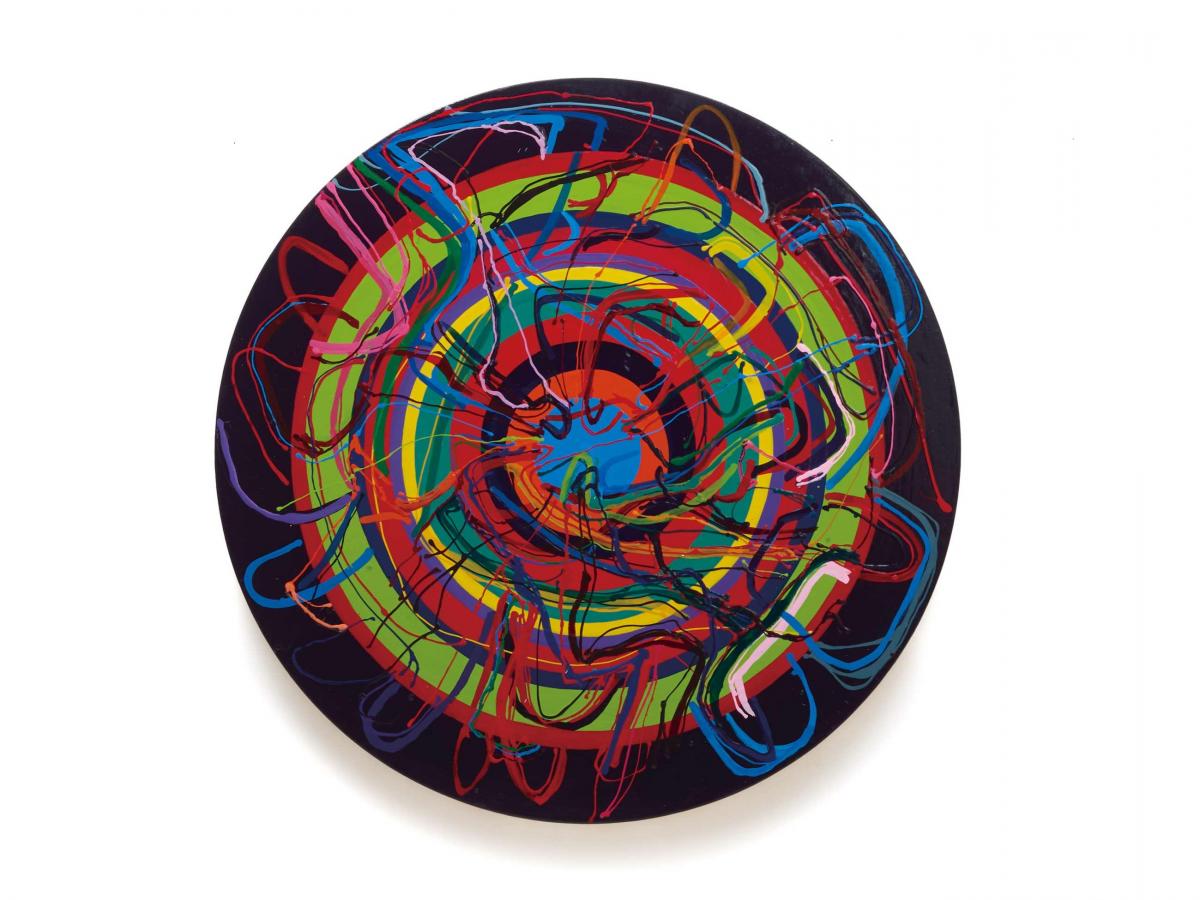
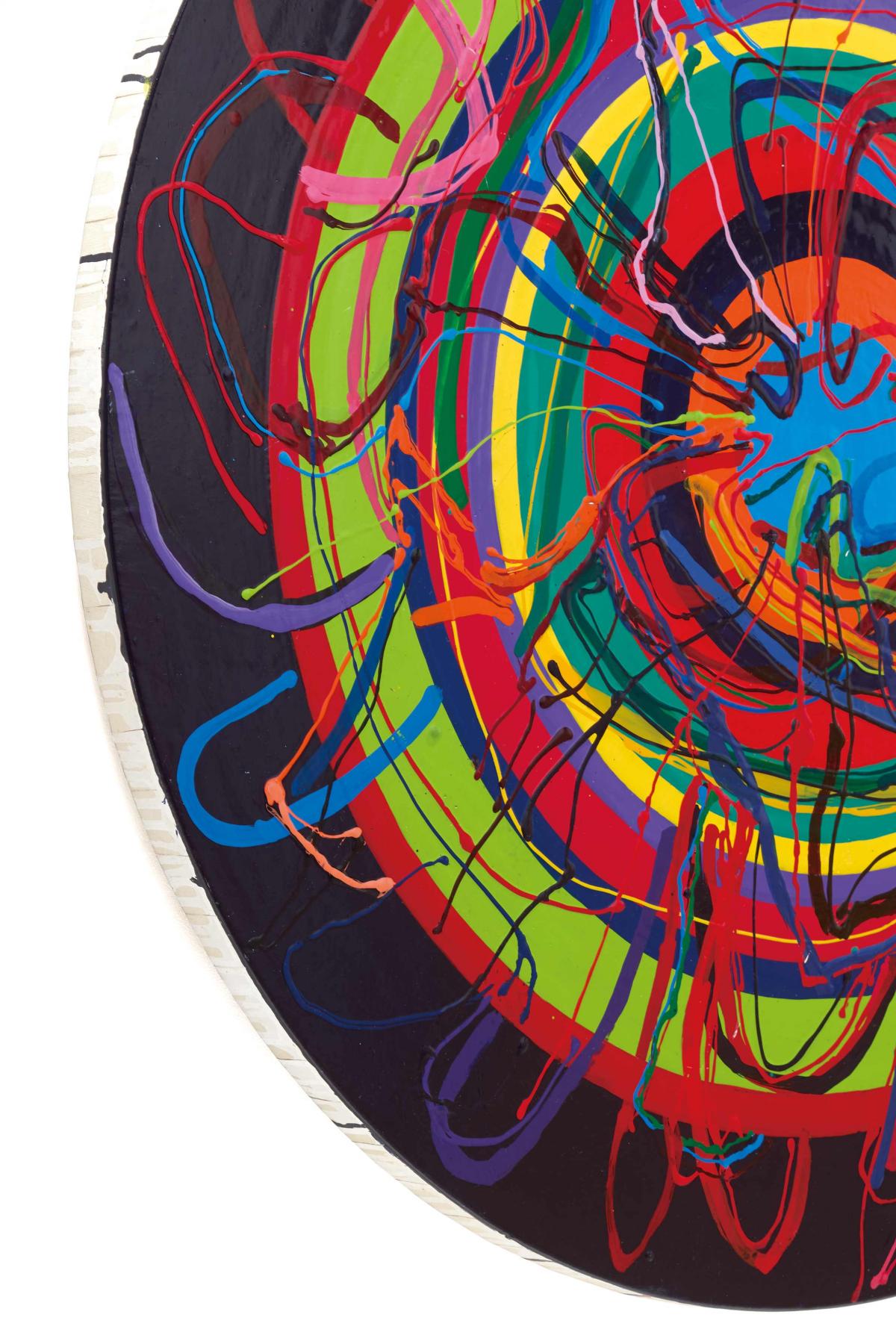
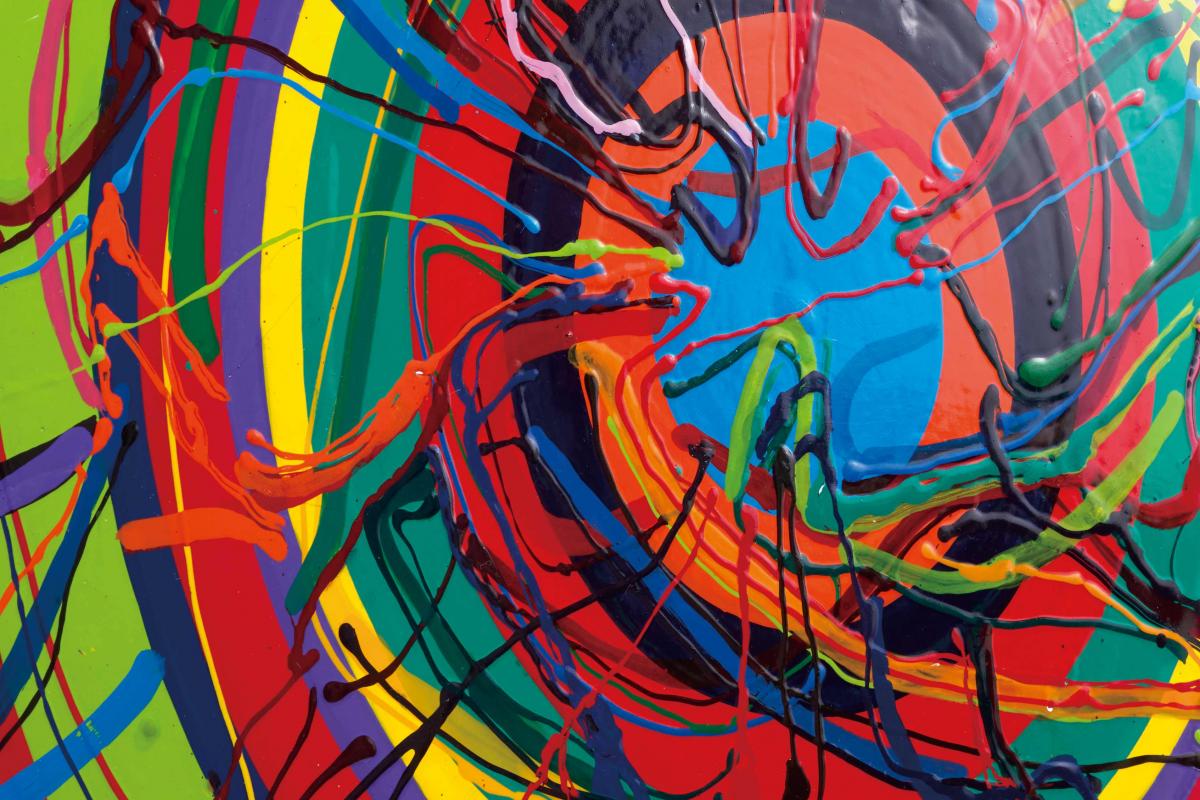
This circular painting, created in 1991, is representative of Atsuko Tanaka's late period. Painted in synthetic enamel on canvas mounted on a wooden panel 90 cm in diameter, it presents concentric rings of red, green, yellow and blue layered repeatedly over a black ground. Vividly coloured lines intertwine across the surface, converging towards the centre, while the poured paint leaves a glossy surface with a subtle sense of thickness once dry. Other works in the same format, including '91A and '91f, were produced in the same year, reflecting Tanaka's constant exploration of the circle as a form. The coloured rings and network of lines have been her central subject ever since she began translating the 1956 Electric Dress into two dimensions, but here the circular shape of the canvas itself becomes a metaphor for a luminous ring, creating a sense of energy radiating outward from, and returning to, the centre in a continuous cycle. The work was shown in Tanaka's solo exhibition at Gallery Kuranuki, Osaka, held from November to December of the same year, and is reproduced in the Atsuko Tanaka Catalogue Raisonné (Galleria Col, Hiroshima, 2015, pp. 386–387).
- PROVENANCE
-
Gallery HAM, Nagoya
- LITERATURE
-
Galleria Col, Atsuko Tanaka Catalogue Raisonné, Hiroshima 2015, pp. 386-387, illustrated
Mizuho Kato, Miyuki Minami and Ming Tampo, eds., Atsuko Tanaka: Search for an Unknown Aesthetic, 1954-2000, Japan 2001, p. 185, illustrated
art NIKKEI, 1 July 1992, p. 50
Exh. Cat., Osaka, Gallery Kuranuki, ATSUKO TANAKA, November - December 1991, n.p., illustrated